Platform comparison
| Platform | YES odds | NO odds | Fee | KYC | Settlement | |
|---|---|---|---|---|---|---|
Polymarket (via Best Prediction Markets UK) Pick polygram.ink (preferred broker) |
24% | 76% | 0% (USDC on-chain) | No-KYC up to $1,500 | USDC, auto via UMA oracle | View on Polymarket → |
Polymarket (direct) polymarket.com |
24% | 76% | 0% | Geo-blocked in US/UK/EU | USDC, on-chain | View on Polymarket → |
Kalshi kalshi.com |
— | — | Up to 7% per trade | US-only, KYC required | USD | View on Polymarket → |
Betfair Exchange betfair.com |
— | — | 2-5% commission | Full KYC from first trade | GBP / EUR | View on Polymarket → |
Manifold Markets manifold.markets |
— | — | Play-money (mana) | None — play-money | Mana (no cash-out) | View on Polymarket → |
Outcome probabilities
Current market-implied probability for each outcome, from the live order book.
| Outcome | Probability |
|---|---|
| Somaliland | 24% |
| Qatar | 12% |
| Syria | 12% |
| Jordan | 10% |
| Kuwait | 10% |
| Lebanon | 10% |
| Turkey | 9% |
| Saudi Arabia | 9% |
| Egypt | 8% |
| Azerbaijan | 7% |
| Pakistan | 6% |
| Oman | 5% |
Market context
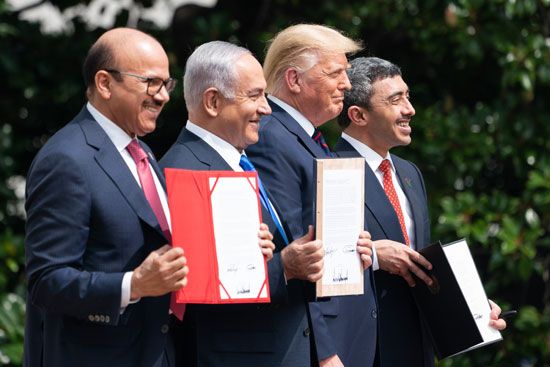
A formal Abraham Accords deal would mean another government publicly signs a normalisation agreement with Israel, and the market is pricing that at just **6%** before the end of 2026. That is a low bar relative to the diplomatic attention around the file, but it also reflects how few countries are both willing and able to move from quiet contacts to an explicit accord under the Abraham Accords label. The existing agreements with the UAE, Bahrain, Morocco and Sudan show the framework can produce real breakthroughs, yet each case depended on a distinct set of incentives and political cover rather than a broad regional trend.[3][4]
The comparison set matters because recent commentary has remained cautious: one analysis described an expansion in the short term as *unlikely*, even as Washington has periodically floated wider normalisation.[2] Public signalling from the US has also been mixed, with one report saying Donald Trump announced Kazakhstan as the first country of his second term to join the accords.[1] For traders, the key catalyst is not generic Middle East diplomacy but a concrete, jointly acknowledged signing statement from Israel and a prospective entrant, since the contract resolves only on a formal agreement clearly attributed to the Abraham Accords or its continuation.[3]
What to watch next is whether any government shifts from exploratory talks to a scheduled announcement, because that is where probabilities can reprice quickly. The most relevant signals are White House or foreign ministry read-outs, visits that put normalisation on the official agenda, and any report that a state is being prepared for accession through a public ceremony rather than back-channel contacts. With prediction markets at 6% and no obvious consensus of a near-term signing, the gap between price and analyst tone still suggests a low-probability diplomatic event rather than a base case.[1][2][3]
Methodology
Methodologically we separate two layers: the live probability (Polymarket mid-price) and the platform attributes (fee, KYC, settlement currency, payment rails). That keeps the comparison honest — a single canonical probability across the row, with the venue-by-venue trade-offs spelt out in the columns next to it.
Resolution & payout
Settlement runs on-chain. Polymarket's contract logic separates YES and NO shares as conditional tokens; at resolution the winning share lifts to $1.00 and the losing one to $0. The outcome input comes from the UMA Optimistic Oracle, which secures against bad resolution with a bond + dispute window.
Once finalised, the smart contract pays USDC to the holders' wallets within minutes — no withdrawal fees beyond Polygon network gas. Kalshi settles in USD via CFTC clearance, Betfair in account currency net of commission, Manifold in play-money mana with no cash-out.
FAQ
- Is this market available outside the US?
- Polymarket itself is geo-blocked in the US/UK/EU. Always check the legal status of prediction markets in your jurisdiction before trading.
- How does resolution work?
- Through the UMA Optimistic Oracle on Polygon: a proposer submits the outcome, a two-hour challenge window opens, and USDC payouts settle automatically once the result is final.
- What's the difference between YES and NO shares?
- A YES share pays $1.00 if the event happens, $0 otherwise. A NO share pays $1.00 if the event doesn't happen. The market price between 0¢ and 100¢ is the implied probability.
- Do I need to KYC for this market?
- On Polymarket directly, no — it's wallet-based. Intermediary brokers like Best Prediction Markets UK trigger KYC only above $1,500 of lifetime trading volume; under that you trade pseudonymously with a single wallet address.
- How reliable are the quoted odds?
- The YES/NO percentages are the live mid-prices of the Polymarket order book. On deep markets they move every few seconds; on thinner ones you'll see short plateaus.
%22%2F%3E%3Cpath%20d%3D%22M%206%2066%20A%2026%2026%200%200%201%2058%2066%22%20fill%3D%22%23E6B98D%22%20opacity%3D%220.9%22%2F%3E%3Ccircle%20cx%3D%2232%22%20cy%3D%2226%22%20r%3D%2222%22%20fill%3D%22%23F5CBA7%22%2F%3E%3Cpath%20d%3D%22M%2010%2018%20Q%2016%204%2026%2010%20Q%2020%202%2032%206%20Q%2044%202%2038%2010%20Q%2048%204%2054%2018%22%20stroke%3D%22%2322d3ee%22%20stroke-width%3D%224%22%20fill%3D%22none%22%20stroke-linecap%3D%22round%22%2F%3E%3C%2Fsvg%3E) and
and%22%2F%3E%3Cpath%20d%3D%22M%206%2066%20A%2026%2026%200%200%201%2058%2066%22%20fill%3D%22%23E6B98D%22%20opacity%3D%220.9%22%2F%3E%3Ccircle%20cx%3D%2232%22%20cy%3D%2226%22%20r%3D%2222%22%20fill%3D%22%23F5CBA7%22%2F%3E%3Cpath%20d%3D%22M%2010%2026%20A%2022%2028%200%200%201%2054%2026%22%20fill%3D%22%2322d3ee%22%20opacity%3D%220.9%22%2F%3E%3C%2Fsvg%3E)
Trade Which country will join Abraham Accords before 2027? on Best Prediction Markets UK
Live order book, 0% fees, USDC settlement in seconds.
Open live market →